Paying even a little extra toward principal each month cuts years off a mortgage. On a $360,000 30-year loan at 7.32%, adding $200 a month pays the loan off 6 years and 4 months early and saves $132,730 in interest. Because every extra dollar skips decades of interest, the earliest extra payments save the most.
Below are the exact savings for common strategies, how to make sure your extra money goes to principal, and when you’re better off investing or paying down other debt first.
Key takeaways
- At today’s rates, extra principal earns a guaranteed return equal to your mortgage rate, 7.32% on a new loan.
- One extra payment a year, the effect of biweekly payments, saves about $130,000 on this loan.
- Tell your servicer to apply extra money to principal, and check your statement to confirm it.
- Build an emergency fund and pay off higher-rate debt first. Money in your home is hard to get back out.
In this guide: Savings by strategy · Biweekly payments · Lump sums and recasting · Pay off or invest? · How to do it · FAQ
How much you save with extra payments
All figures are for a $360,000 30-year fixed loan at 7.32%, with principal and interest of $2,472.95 a month and $530,262 in total interest if you make only the required payments.
| Strategy | Paid off in | Time saved | Interest saved |
|---|---|---|---|
| Required payments only | 30 years | – | – |
| $100 extra a month | 26 years, 4 months | 3 years, 8 months | $77,653 |
| $200 extra a month | 23 years, 8 months | 6 years, 4 months | $132,730 |
| One extra payment a year (biweekly) | 23 years, 9 months | 6 years, 3 months | $130,456 |
| $500 extra a month | 18 years, 5 months | 11 years, 7 months | $234,251 |
| $1,000 extra a month | 13 years, 9 months | 16 years, 3 months | $318,886 |
| $10,000 one-time, at the start | 27 years, 4 months | 2 years, 8 months | $70,498 |
Compare that with a 15-year loan at 6.68%: the payment is $3,172, about $700 more than the 30-year, but you can’t fall back to a lower payment if money gets tight. Paying extra on a 30-year keeps that flexibility. Our 15-year vs. 30-year guide compares both in detail.
Extra Payment Calculator: See Your New Payoff Date
Full guide: mortgage payment calculator with taxes, insurance and PMI
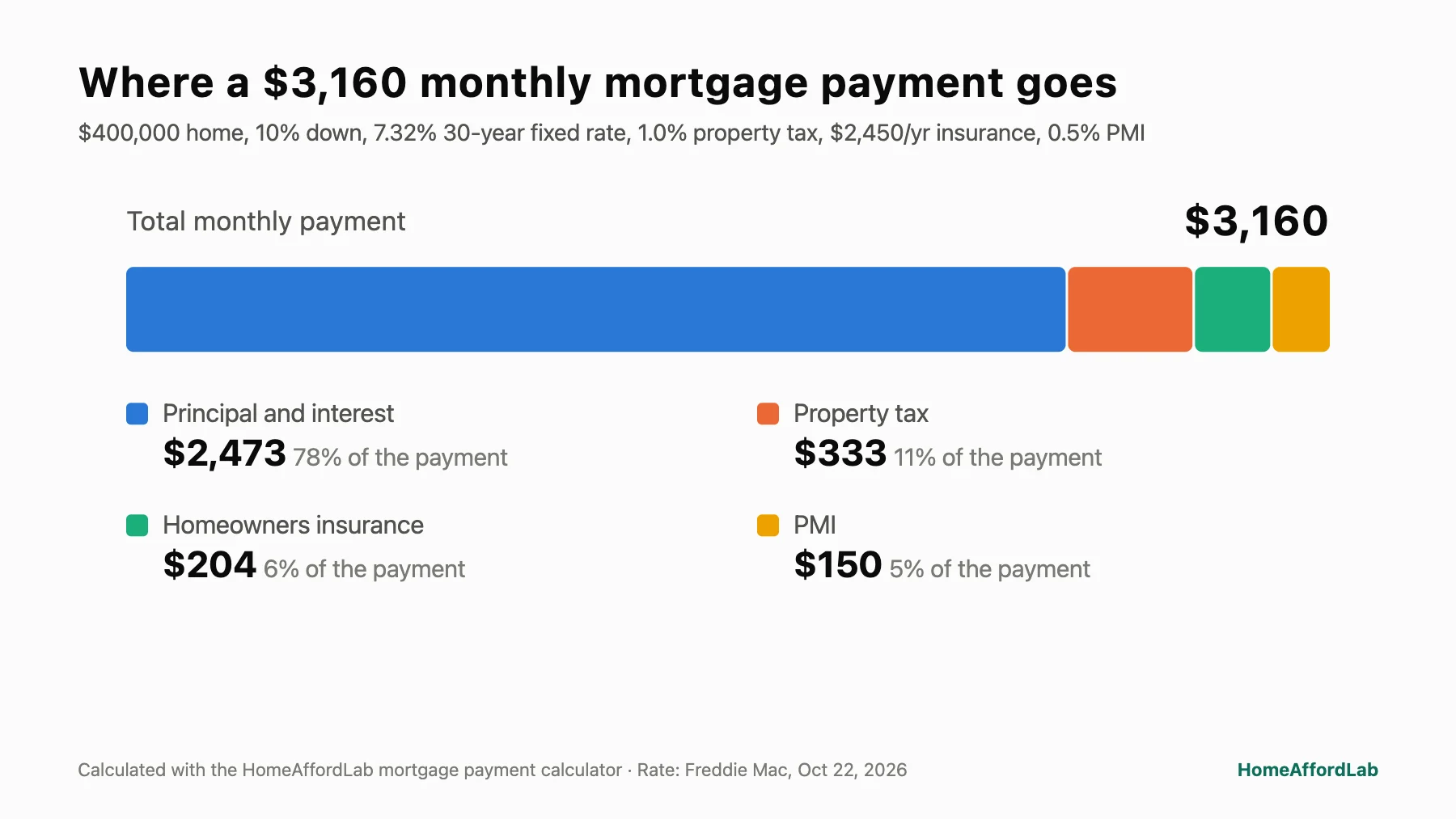
Your full monthly payment: principal, interest, property tax, homeowners insurance, PMI or FHA mortgage insurance, and HOA dues.
Loan balance and what you pay over time
Each year’s principal and interest, and the balance left at year end.
Year-by-year amortization table
| Year | Principal | Interest | Balance |
|---|
Do biweekly payments really help?
Paying half your payment every two weeks adds up to 26 half-payments, or 13 full payments, a year. That one extra payment is what saves the money. You get the same result by adding 1/12 of a payment, about $206 here, to each monthly payment.
Be careful with third-party biweekly programs that charge setup or monthly fees. Some also hold your money and send it to the servicer once a month, so you pay fees for something you can do yourself for free.
Lump sums and recasting
A bonus, tax refund or inheritance can go straight to principal. A $10,000 payment at the start of this loan saves about $70,500 in interest, roughly seven times the amount paid.
A lump sum shortens the loan but doesn’t lower your monthly payment. If you’d rather have a lower payment, ask your servicer about a recast: you pay down a large amount, often $5,000 to $10,000 or more, pay a fee of around $150 to $500, and the servicer recalculates your payment over the remaining term. Most conventional loans allow it. FHA, VA and USDA loans usually don’t. See more options in how to lower your mortgage payment.
Should you pay off your mortgage or invest?
An extra payment earns exactly your mortgage rate, risk-free. Investing may earn more over long periods, but the return isn’t guaranteed. A simple order of priorities:
- Get any employer 401(k) match. It’s an instant return you can’t beat.
- Build an emergency fund of three to six months of expenses, including your mortgage payment.
- Pay off higher-rate debt like credit cards and car loans.
- Then decide. With a mortgage rate above 7%, extra payments are an attractive, risk-free choice. With a rate of 3% or 4% from a few years ago, investing the money or keeping it in savings that earns more is often better.
Paying down the mortgage can also help if you want to remove PMI sooner. On a conventional loan, PMI can be canceled once you reach 20% equity, which extra payments speed up.
How to make extra payments the right way
- Check for a prepayment penalty in your loan documents. They’re rare: FHA, VA and USDA loans don’t allow them, and federal rules limit them on most other loans to the first three years.
- Mark extra money as “principal only” in your servicer’s online portal or on the check.
- Pay the regular amount first. Extra money sent instead of a full payment can be held or applied to interest.
- Check your next statement to make sure the principal balance dropped by the extra amount.
- Automate it. A recurring extra amount is easier to keep up than occasional large payments.
Frequently asked questions
Is it better to pay extra monthly or once a year?
Monthly is slightly better because each extra dollar starts saving interest sooner. The difference is small, so choose whichever you’re more likely to keep doing.
Does paying extra lower my monthly payment?
No. On a fixed-rate loan, the payment stays the same and the loan ends sooner. Only a recast or refinance lowers the payment.
Do extra payments lower my escrow or taxes?
No. Property taxes and insurance are based on your home and policy, not your loan balance, so the escrow part of your payment doesn’t change.
What happens after I pay off my mortgage?
You’ll receive a lien release, and you’ll need to pay property taxes and homeowners insurance yourself, since there’s no longer an escrow account.
The bottom line
Small, regular extra payments are one of the safest ways to save six figures on a mortgage at today’s rates. Cover your emergency fund and higher-rate debt first, then put whatever you can toward principal, starting as early as possible.
Estimates only. HomeAffordLab is not a lender and does not provide financial advice. This page may contain ads. See our Advertising Disclosure.
Sources: Freddie Mac Primary Mortgage Market Survey, Oct 22, 2026 · CFPB: Ability-to-Repay and Qualified Mortgage rule, prepayment penalty limits (12 CFR 1026.43(g)) · CFPB: Can I prepay my loan? · HomeAffordLab amortization calculations