
By the HomeAffordLab team · Last updated October 27, 2026
You don’t need 20% down to buy a house. Conventional loans allow as little as 3% down, FHA loans 3.5%, and VA and USDA loans 0% for eligible buyers. According to the National Association of Realtors’ 2025 Profile of Home Buyers and Sellers, the typical first-time buyer put down 10%, and the typical repeat buyer put down 23%.
On a $400,000 home, that means a down payment anywhere from $12,000 to $80,000. This guide shows what each option costs per month at today’s rates, how much cash you really need at closing, and how to decide how much to put down.
Key takeaways
- Minimum down payments: 3% conventional, 3.5% FHA (10% with a credit score of 500 to 579), 0% VA and USDA.
- Putting less than 20% down on a conventional loan usually means paying PMI until you reach enough equity.
- On a $400,000 home at 7.32%, going from 3% down to 20% down lowers the monthly payment by about $628.
- Budget for closing costs of roughly 2% to 5% of the price on top of the down payment.
- Don’t empty your savings. Keeping an emergency fund after closing matters more than avoiding PMI.
In this guide: Minimums by loan type · Payments by down payment · Total cash needed · Is 20% worth it? · Where the money can come from · How to save faster · FAQ
How Much House Can I Afford? Calculator
Includes property tax, homeowners insurance, PMI or FHA mortgage insurance, and HOA dues.
Minimum down payment by loan type
| Loan type | Minimum down payment | On a $400,000 home | Who it’s for |
|---|---|---|---|
| Conventional (first-time buyer and low-down-payment programs) | 3% | $12,000 | Buyers with fair to strong credit; some programs have income limits |
| Conventional (standard) | 5% | $20,000 | Most conventional borrowers |
| FHA | 3.5% (10% with a 500–579 score) | $14,000 | Buyers with lower credit scores or higher debt |
| VA | 0% | $0 | Eligible veterans, service members, and some surviving spouses |
| USDA | 0% | $0 | Moderate-income buyers in eligible rural and suburban areas |
| Jumbo | Often 10% to 20% | Not applicable at this price | Loans above the conforming limit of $832,750 in most counties |
Monthly payment by down payment
The table compares down payments on a $400,000 home at a 7.32% 30-year rate, with 1.0% property tax and $2,450 a year in homeowners insurance. Conventional loans assume a PMI rate of 0.5%, typical for strong credit. The FHA row includes the 1.75% upfront premium added to the loan and 0.55% annual MIP.
| Down payment | Amount | Loan | Principal and interest | Mortgage insurance | Full monthly payment |
|---|---|---|---|---|---|
| 3% (conventional) | $12,000 | $388,000 | $2,665 | $162 | $3,364 |
| 3.5% (FHA) | $14,000 | $392,755 | $2,698 | $177 | $3,412 |
| 5% (conventional) | $20,000 | $380,000 | $2,610 | $158 | $3,306 |
| 10% (conventional) | $40,000 | $360,000 | $2,473 | $150 | $3,160 |
| 20% (conventional) | $80,000 | $320,000 | $2,198 | $0 | $2,736 |
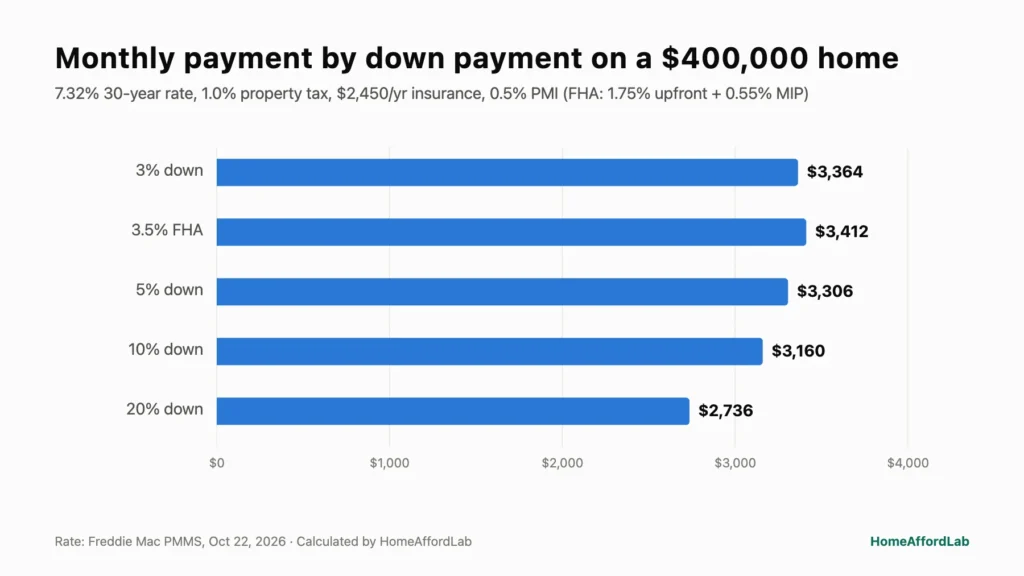
Each step up lowers the payment, but the biggest single drop comes at 20%, when PMI disappears. If your credit score is below about 700, PMI costs more than the 0.5% assumed here, which makes a bigger down payment, or an FHA loan, relatively more attractive. Our PMI guide shows the cost by credit score.
How much cash you really need
The down payment isn’t the only check you’ll write. Plan for:
- Closing costs: usually 2% to 5% of the price, covering lender fees, title insurance, appraisal, and prepaid taxes and insurance. On a $400,000 home, that’s about $8,000 to $20,000.
- Cash reserves: some lenders want you to have one or more months of mortgage payments left in the bank after closing.
- Moving and setup costs: movers, utility deposits, and basic furniture.
- An emergency fund: three to six months of expenses, kept separate from everything above.
Assuming closing costs of 3%, the cash needed at closing on a $400,000 home would be about $24,000 with 3% down, $52,000 with 10% down, and $92,000 with 20% down. You can sometimes reduce closing costs by negotiating seller credits or choosing a lender credit in exchange for a slightly higher rate.
Is putting 20% down worth it?
Reasons to put down more:
- No PMI on a conventional loan, which saved $150 a month in our example.
- A smaller loan, less total interest, and a lower monthly payment.
- More equity if prices fall, making it easier to sell or refinance.
- Sometimes a slightly better rate.
Reasons to put down less:
- You can buy years sooner instead of chasing rising prices while you save.
- You keep an emergency fund and money for repairs, which new owners almost always need.
- PMI on a conventional loan can be removed later, once you reach 20% equity.
- Paying off high-interest debt first may be worth more than avoiding PMI.
For many first-time buyers, the right answer is the down payment that leaves a full emergency fund intact and keeps the monthly payment within the 28/36 rule. Use our affordability calculator to test different amounts.
Where your down payment can come from
- Savings and checking: lenders usually ask for two months of statements and explanations for large recent deposits.
- Gifts from family: conventional, FHA, and VA loans allow gift funds with a signed gift letter stating the money doesn’t need to be repaid.
- Down payment assistance: most states and many cities offer grants or low-interest second loans for first-time buyers, often with income and price limits.
- Retirement accounts: 401(k) loans and first-time buyer IRA withdrawals of up to $10,000 are possible, but they reduce your retirement savings and can carry taxes or penalties, so get tax advice first.
- Proceeds from selling a home if you already own one.
How long does it take to save?
Saving 10% for a $400,000 home, or $40,000, takes about 80 months at $500 a month and about 40 months at $1,000 a month, before any interest. A high-yield savings account helps, and so does automating a transfer on payday. Many buyers combine savings with a family gift or an assistance program to shorten the timeline.
Frequently asked questions
Can I buy a house with no money down?
Yes, with a VA or USDA loan if you qualify. You’ll still usually need cash for closing costs, unless the seller or an assistance program covers them.
Is it better to put 10% or 20% down?
20% avoids PMI and lowers the payment, but only if it doesn’t drain your emergency savings. With 10% down, PMI on a conventional loan can be removed once you reach 20% equity.
Does the down payment affect my interest rate?
It can. Conventional loan pricing often improves with a larger down payment, and PMI costs drop significantly as your down payment rises.
Can closing costs be added to the loan?
Usually not on a purchase, but you can ask the seller to pay some of them or accept a lender credit in exchange for a higher rate. FHA’s upfront mortgage insurance premium is the main cost that’s commonly financed.
The bottom line
The minimum down payment is lower than most people think, 3% conventional, 3.5% FHA, and 0% for VA and USDA, and the typical first-time buyer puts down 10%. Put down enough to keep your payment comfortable, but not so much that you have no cushion left after closing. Try different amounts in the calculator above to find your balance.
Estimates only. HomeAffordLab is not a lender and does not provide financial advice. This page may contain ads. See our Advertising Disclosure.
Sources: National Association of Realtors: 2025 Profile of Home Buyers and Sellers · HUD (FHA requirements) · U.S. Department of Veterans Affairs · USDA Rural Development · Freddie Mac Primary Mortgage Market Survey