
By the HomeAffordLab team · Last updated October 27, 2026
On a $320,000 loan, a 15-year mortgage at 6.68% costs about $2,819 a month in principal and interest, while a 30-year mortgage at 7.32% costs about $2,198. The 15-year payment is $621 higher, but it saves about $283,869 in interest and pays the home off in half the time.
Those are the averages Freddie Mac reported on October 22, 2026: 7.32% for 30-year loans and 6.68% for 15-year loans. This guide compares the two terms with real numbers and explains who should choose each, plus a middle option many buyers overlook.
Key takeaways
- 15-year mortgages usually carry lower rates. On October 22, 2026, the gap was 0.64 percentage points.
- On a $320,000 loan, the 15-year payment is about 28% higher but cuts total interest by about 60%.
- A 30-year loan keeps the required payment low, which makes it easier to qualify and leaves room for savings.
- Paying a 30-year loan as if it were a 15-year loan is flexible, but it costs more interest than a true 15-year loan because of the higher rate.
In this guide: Side-by-side comparison · Payments by loan amount · Equity over time · The middle option · Who should choose each · Qualifying · FAQ
Mortgage Payment Calculator
Your full monthly payment: principal, interest, property tax, homeowners insurance, PMI or FHA mortgage insurance, and HOA dues.
Loan balance and what you pay over time
Each year’s principal and interest, and the balance left at year end.
Year-by-year amortization table
| Year | Principal | Interest | Balance |
|---|
15-year vs. 30-year mortgage: side by side
The table compares a $320,000 loan, the amount you’d borrow on a $400,000 home with 20% down, at the October 22, 2026 average rates.
| 30-year fixed | 15-year fixed | |
|---|---|---|
| Interest rate | 7.32% | 6.68% |
| Monthly principal and interest | $2,198 | $2,819 |
| Total interest paid | $471,344 | $187,475 |
| Total of all payments | $791,344 | $507,475 |
| Balance after 5 years | $302,229 | $246,301 |
| Balance after 10 years | $276,632 | $143,472 |
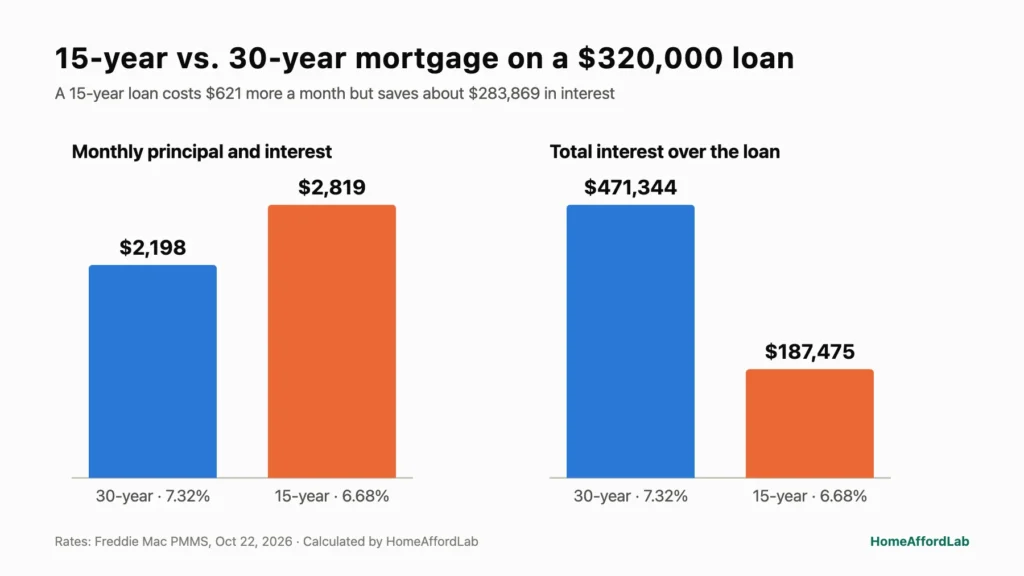
Property taxes, insurance, and any HOA dues are the same under both terms, so the difference you’ll feel each month is only the principal and interest. With 20% down there’s no PMI on either loan.
Monthly payment and interest by loan amount
| Loan amount | 30-year payment (7.32%) | 15-year payment (6.68%) | Extra per month | Interest saved |
|---|---|---|---|---|
| $200,000 | $1,374 | $1,762 | $388 | $177,418 |
| $300,000 | $2,061 | $2,643 | $582 | $266,127 |
| $400,000 | $2,748 | $3,524 | $776 | $354,836 |
| $500,000 | $3,435 | $4,405 | $971 | $443,545 |
The pattern holds at every loan size: the 15-year payment is roughly 28% higher, and it saves well over half of the interest.
How fast you build equity
A 30-year loan is front-loaded with interest. After five years on our $320,000 example, you’d still owe $302,229, having paid off less than 6% of the loan. With a 15-year loan, you’d owe $246,301, which is about 23% paid off.
Faster equity matters if home prices fall, if you want to sell or refinance, or if you’d like to remove a home from your monthly budget before retirement. It also means you’d reach 20% equity much sooner if you start with a smaller down payment, so any PMI ends years earlier.
The middle option: a 30-year loan with extra payments
You can take a 30-year loan and pay extra toward principal whenever you can. This keeps the required payment low in case money gets tight, but it costs more than a real 15-year loan because the rate is higher.
- Pay the 15-year amount on a 30-year loan. Paying $2,819 a month on the $320,000 30-year loan at 7.32% pays it off in about 16 years and 2 months, with about $226,506 in interest.
- Finish the 30-year loan in exactly 15 years. That takes about $2,934 a month and costs about $208,084 in interest, roughly $20,600 more than the 15-year loan.
So the flexibility of a 30-year loan with extra payments costs about $115 more a month, or about $20,600 over 15 years, compared with committing to a 15-year term. For many buyers, that’s a fair price for a lower required payment.
Who should choose a 15-year or a 30-year mortgage?
A 15-year mortgage can make sense if you:
- Can afford the higher payment and still save for emergencies and retirement.
- Have stable income and want to own your home outright sooner, for example before retirement.
- Are refinancing a loan you’ve already paid down for several years.
- Want the lowest total cost and don’t need the cash flow for other goals.
A 30-year mortgage can make sense if you:
- Are a first-time buyer and need the lower payment to qualify or to stay within the 28/36 rule.
- Have high-interest debt or no emergency fund yet. Paying those first usually beats prepaying a mortgage.
- Want flexibility for uneven income, a growing family, or other investments.
- Plan to pay extra when you can, without being locked into a higher required payment.
How the term affects how much you can borrow
Lenders judge you on the required monthly payment, so the higher 15-year payment lowers the loan you can qualify for. At these rates, the same principal-and-interest budget of $2,198 a month supports a $320,000 loan on a 30-year term but only about $250,000 on a 15-year term.
Before choosing a term, check your budget with our home affordability calculator. You can switch it between 30-year and 15-year terms to see how the comfortable price changes.
Frequently asked questions
Why are 15-year mortgage rates lower?
Lenders get their money back sooner, so they face less risk from rising rates and borrower defaults over time. That lower risk shows up as a lower rate, which was 0.64 points lower on average on October 22, 2026.
Can I switch from a 30-year to a 15-year loan later?
Yes, by refinancing, but you’ll pay closing costs again and get whatever rates are available then. Making extra principal payments on your existing loan gives a similar result without a new loan.
Is a 20-year mortgage a good compromise?
It can be. Many lenders offer 20-year and other terms between 10 and 30 years. The payment and interest land between the two options compared here, and rates are often close to 30-year rates.
Does a 15-year loan need a bigger down payment?
No. The down payment rules are the same. The difference is the monthly payment, which affects whether your income qualifies.
The bottom line
A 15-year mortgage saves a lot of money, about $284,000 in interest on a $320,000 loan at today’s rates, but it raises the payment by about $621 a month. Choose it if that payment fits comfortably alongside your other goals. Otherwise, a 30-year loan with extra payments when you can afford them gives you most of the savings with more breathing room. Compare both terms with your own numbers in the calculator above.
Estimates only. HomeAffordLab is not a lender and does not provide financial advice. This page may contain ads. See our Advertising Disclosure.
Sources: Freddie Mac Primary Mortgage Market Survey (rates for October 22, 2026) · Payment and interest figures calculated by HomeAffordLab using standard amortization