
By the HomeAffordLab team · Last updated October 27, 2026
Private mortgage insurance (PMI) usually costs between 0.46% and 1.50% of the loan amount per year, depending mostly on your credit score and down payment. On a $350,000 home with 3.5% down, that works out to about $129 a month with a credit score of 760 or higher and about $422 a month with a score of 620 to 639.
The good news is that PMI on a conventional loan doesn’t last forever. Federal law lets you ask your lender to cancel it once your balance reaches 80% of the home’s original value, and it must end automatically at 78%. This guide explains what PMI costs, how long you’ll pay it, and the fastest ways to get rid of it.
Key takeaways
- Lenders usually require PMI on conventional loans when you put down less than 20%.
- PMI typically costs 0.46% to 1.50% of the loan per year, and your credit score is the biggest factor.
- You can request cancellation at 80% of the original value, and PMI ends automatically at 78%.
- On a $337,750 loan at 7.32%, scheduled payments reach 78% in about 12 years and 8 months. An extra $200 a month gets you there in about 8 years and 6 months.
- FHA loans charge a different kind of mortgage insurance (MIP) that often can’t be canceled.
In this guide: What PMI is · How much PMI costs · PMI by credit score · How long you pay · How to remove PMI · How to avoid PMI · PMI vs. FHA MIP · FAQ
Mortgage Payment Calculator
Your full monthly payment: principal, interest, property tax, homeowners insurance, PMI or FHA mortgage insurance, and HOA dues.
Loan balance and what you pay over time
Each year’s principal and interest, and the balance left at year end.
Year-by-year amortization table
| Year | Principal | Interest | Balance |
|---|
What is private mortgage insurance?
PMI is insurance that protects the lender, not you, if you stop making payments. Lenders take on more risk when a buyer has less equity, so most require PMI on a conventional loan when the down payment is under 20% of the price.
You pay for that protection, but it’s also what makes a 3% or 5% down payment possible. Without PMI, most buyers would need to save 20% before they could buy, which can take many extra years.
PMI usually comes in one of these forms:
- Borrower-paid monthly PMI. The most common type. A monthly premium is added to your mortgage payment and can be canceled later.
- Single-premium PMI. You pay the whole premium upfront at closing, either in cash or by adding it to the loan. There’s no monthly charge, but the money isn’t refunded if you sell or refinance early.
- Lender-paid PMI. The lender pays the premium in exchange for a higher interest rate. There’s no separate PMI line, but the higher rate lasts for the life of the loan unless you refinance.
- Split-premium PMI. Part upfront and part monthly, which lowers the monthly charge.
How much does PMI cost?
PMI is quoted as an annual percentage of the loan amount and divided into 12 monthly payments. The formula is simple:
Monthly PMI = loan amount × annual PMI rate ÷ 12
For example, a $337,750 loan with a 0.70% PMI rate costs $337,750 × 0.007 ÷ 12 = about $197 a month.
The rate you’re offered depends on three things:
- Credit score. The biggest factor. Lower scores pay much higher rates.
- Down payment. The less you put down, the higher the rate. A buyer with 15% down pays far less than one with 3% down.
- Loan details. Your debt-to-income ratio, the loan term, and whether the home is a primary residence can also change the price.
PMI cost by credit score
Urban Institute data cited by Experian shows how much PMI rates rise as credit scores fall for buyers with a small down payment. The table applies those rates to a $350,000 home with 3.5% down, a $337,750 loan, and a 7.32% 30-year rate, with 1.0% property tax and $2,450 a year in insurance.
| Credit score | Annual PMI rate | Monthly PMI | Full monthly payment | Total PMI until it ends at 78% |
|---|---|---|---|---|
| 760+ | 0.46% | $129 | $2,945 | $19,680 |
| 740–759 | 0.58% | $163 | $2,979 | $24,813 |
| 720–739 | 0.70% | $197 | $3,013 | $29,947 |
| 700–719 | 0.79% | $222 | $3,038 | $33,798 |
| 680–699 | 0.98% | $276 | $3,092 | $41,926 |
| 660–679 | 1.23% | $346 | $3,162 | $52,621 |
| 640–659 | 1.31% | $369 | $3,185 | $56,044 |
| 620–639 | 1.50% | $422 | $3,238 | $64,173 |
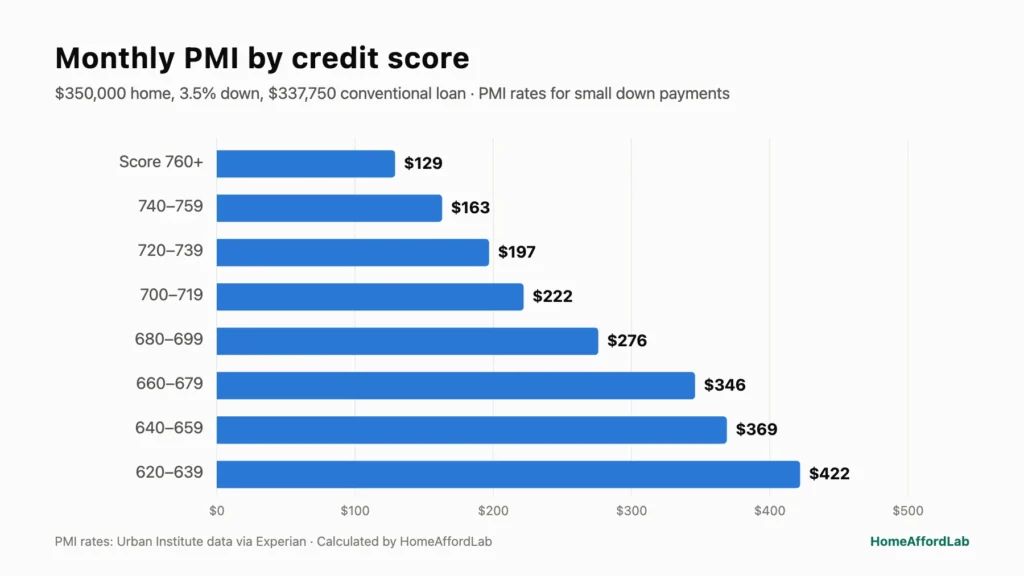
The gap is large. Over the time it takes to reach 78%, a buyer with a 620 score pays about $44,000 more in PMI than a buyer with a 760 score on the same home. Raising your score before you apply is often the cheapest way to cut PMI.
How long do you pay PMI?
With scheduled payments only, PMI lasts until your balance falls to 78% of the home’s original value. How long that takes depends on your down payment and interest rate.
In our example, a $337,750 loan at 7.32% reaches 80% of the original $350,000 value after about 11 years and 9 months and 78% after about 12 years and 8 months. With a smaller balance or a lower rate, you get there sooner, because more of each payment goes to principal.
Use the mortgage payment calculator above to see your own PMI end date. It shows the month your PMI stops based on your loan, rate, and any extra payments.
How to remove PMI
The Homeowners Protection Act gives you three ways out of borrower-paid PMI on most conventional loans for a primary residence:
- Ask to cancel at 80%. Once your balance is scheduled to reach, or you pay it down to, 80% of the original value, you can request cancellation in writing. You need a good payment history, no second mortgage on the home, and the lender may require proof that the home’s value hasn’t fallen.
- Automatic termination at 78%. PMI must end automatically on the date your balance is scheduled to reach 78% of the original value, as long as you’re current on payments.
- Final termination at the midpoint. If PMI hasn’t ended by the midpoint of the loan, 15 years into a 30-year mortgage, it must end the following month, as long as you’re current.
There are also two faster routes the law doesn’t require but many lenders allow:
- Make extra principal payments. In our example, adding $200 a month reaches 78% in about 8 years and 6 months instead of 12 years and 8 months, and you can request cancellation even earlier at 80%.
- Use your home’s current value. If your home has gone up in value or you’ve remodeled, a new appraisal may show you’ve reached the required equity. Fannie Mae and Freddie Mac loans generally require a balance of 75% of the current value if the loan is two to five years old and 80% after five years. Ask your servicer for its exact rules before ordering an appraisal.
How to avoid PMI
- Put down 20% or more. The simplest option, but it can take years to save on a typical home.
- Use a piggyback loan. An 80-10-10 setup combines a first mortgage for 80%, a second mortgage for 10%, and 10% down. You avoid PMI, but the second loan usually has a higher rate.
- Choose lender-paid PMI. No monthly PMI charge, but a higher rate for the life of the loan. It can make sense if you expect to sell or refinance within a few years.
- Check VA eligibility. VA loans for eligible veterans and service members require no down payment and no monthly mortgage insurance, though most borrowers pay a one-time funding fee.
- Ask about bank programs. Some banks and credit unions offer low-down-payment loans without PMI for qualifying buyers, often with income limits.
PMI vs. FHA mortgage insurance (MIP)
FHA loans don’t use PMI. They charge mortgage insurance premiums (MIP) set by HUD: a 1.75% upfront premium plus an annual premium, usually 0.55% of the loan. Unlike PMI, FHA’s annual rate is the same for every credit score, which is why FHA often costs less than a conventional loan for buyers with scores below about 680.
| Conventional PMI | FHA MIP | |
|---|---|---|
| Priced by credit score | Yes | No |
| Upfront cost | Usually none | 1.75% of the loan |
| Typical annual cost | 0.46% to 1.50% | 0.50% to 0.55% on most loans |
| When it ends | At 78% of original value, or earlier on request | After 11 years with 10% or more down; otherwise for the life of the loan |
To compare both options with your own numbers, use our FHA loan calculator. It shows the FHA payment and a conventional payment with PMI side by side.
Frequently asked questions
Is PMI tax deductible?
For tax years 2026 and later, mortgage insurance premiums are again treated as deductible mortgage interest for taxpayers who itemize, under the 2025 tax law. Income limits and other rules apply, so check IRS guidance or ask a tax professional before counting on the deduction.
Does PMI go away when my home value goes up?
Not automatically. The automatic 78% rule is based on the original value. To use a higher current value, you usually need to request cancellation and pay for a new appraisal, and your loan may need to be at least two years old.
Can I get PMI removed before 20% equity?
Generally no. The earliest point for borrower-paid PMI is when your balance reaches 80% of the original value, or meets your servicer’s current-value rules.
Is PMI the same as homeowners insurance?
No. Homeowners insurance protects you against damage to your home. PMI protects the lender if you default, and you pay it in addition to homeowners insurance.
The bottom line
PMI lets you buy with less than 20% down, but it isn’t cheap with a lower credit score. Expect roughly 0.46% to 1.50% of the loan per year, plan for it to last around 11 to 13 years on a typical small-down-payment loan at today’s rates, and use extra payments or a new appraisal to remove it sooner. Run your own numbers in the calculator above to see exactly when your PMI ends.
Estimates only. HomeAffordLab is not a lender and does not provide financial advice. This page may contain ads. See our Advertising Disclosure.
Sources: CFPB: When can I remove PMI? · Experian: PMI cost by credit score (Urban Institute data) · Homeowners Protection Act of 1998 · Freddie Mac Primary Mortgage Market Survey