
By the HomeAffordLab team · Last updated October 26, 2026
On a $350,000 home with the FHA minimum of 3.5% down, the monthly payment is about $3,011 at a 7.32% rate: $2,361 in principal and interest, $155 in FHA mortgage insurance (MIP), $292 in property tax, and $204 in homeowners insurance. The loan comes to $343,661, because most buyers add the 1.75% upfront premium of $5,911 to the balance.
This guide is for first-time and lower-credit buyers deciding whether an FHA loan is the right fit. Use the calculator to see your payment, the MIP you’ll pay and for how long, whether you’re under the 2026 loan limit, and how the same purchase looks with a conventional loan.
Key takeaways
- FHA loans allow 3.5% down with a credit score of 580 or higher, or 10% down with a score from 500 to 579.
- Every FHA loan carries a 1.75% upfront premium plus an annual premium, most often 0.55% of the loan per year.
- With less than 10% down, FHA mortgage insurance lasts for the life of the loan unless you refinance or sell.
- At the same interest rate, FHA usually wins below a 680 credit score and conventional usually wins above it.
- The 2026 FHA loan limit for a one-unit home ranges from $541,287 to $1,249,125, depending on the county.
In this guide: What an FHA loan is · 2026 requirements · FHA mortgage insurance · 2026 loan limits · Payments by price · FHA vs. conventional · Removing MIP · Pros and cons · FAQ
FHA Loan Calculator
Monthly payment with FHA mortgage insurance (MIP), 2026 loan limits, and a side-by-side comparison with a conventional loan.
FHA vs. conventional loan
Same price and down payment. Conventional PMI is estimated from your credit band.
| FHA | Conventional |
|---|
What is an FHA loan?
An FHA loan is a mortgage insured by the Federal Housing Administration, part of the U.S. Department of Housing and Urban Development (HUD). The FHA doesn’t lend money itself. It insures approved lenders against losses, which lets them accept smaller down payments and lower credit scores than most conventional loans allow. If you’re an eligible veteran or service member, also compare a VA loan, and if you’re buying outside a major city, check whether a USDA loan is available.
That insurance is paid by the borrower through mortgage insurance premiums, which is the main trade-off. FHA loans are popular with first-time buyers, but you don’t have to be one to qualify.
FHA loan requirements for 2026
| Requirement | FHA rule |
|---|---|
| Credit score and down payment | 580+ with 3.5% down; 500–579 with 10% down. Many lenders set higher minimums. |
| Debt-to-income ratio | Typically 31% for housing and 43% for all debts; higher with compensating factors |
| Mortgage insurance | 1.75% upfront plus an annual premium, usually 0.55% a year |
| Property use | Must be your primary residence, moved into within 60 days of closing |
| Property type | Single-family homes, approved condos, townhouses, and 2–4 unit buildings you live in |
| Appraisal | An FHA appraisal that confirms value and basic safety standards |
| Loan limit | $541,287 to $1,249,125 for one unit in 2026, depending on the county |
| Waiting periods | Generally 2 years after a Chapter 7 bankruptcy and 3 years after a foreclosure |
| Employment | Usually a two-year history of steady income |
Lenders can add their own stricter rules, called overlays, so it’s worth getting quotes from more than one FHA-approved lender if your credit is near a cutoff. Compare with conventional loan requirements, and see what credit score you need for each loan type.
FHA mortgage insurance (MIP) explained
FHA loans charge two premiums. The upfront premium is 1.75% of the base loan, and most borrowers add it to the loan rather than paying it in cash. The annual premium is divided into 12 payments and added to your monthly bill. HUD sets the rates by loan size, term, and down payment:
| Loan term and amount | Down payment | Annual MIP |
|---|---|---|
| Over 15 years, up to $726,200 | Less than 5% | 0.55% |
| Over 15 years, up to $726,200 | 5% or more | 0.50% |
| Over 15 years, above $726,200 | Less than 5% | 0.75% |
| Over 15 years, above $726,200 | 5% or more | 0.70% |
| 15 years or less, up to $726,200 | Less than 10% | 0.40% |
| 15 years or less, up to $726,200 | 10% or more | 0.15% |
How long you pay depends on your down payment. With less than 10% down, the annual premium lasts for the life of the loan. With 10% or more down, it ends after 11 years. In our example, putting 10% down instead of 3.5% lowers the annual rate to 0.50%, cuts the payment to about $2,829, and ends MIP after 11 years.
2026 FHA loan limits
HUD announced that for case numbers assigned on or after January 1, 2026, the one-unit FHA limit is $541,287 in most of the country and up to $1,249,125 in high-cost areas. Limits are higher for 2–4 unit properties. The limit applies to the base loan before the upfront premium is added.
Enter your county’s figure in the calculator’s loan limit field. You can find it with HUD’s FHA mortgage limits lookup. If the loan you need is above the limit, you’ll need a bigger down payment or a different loan type.
FHA monthly payments by home price
The table assumes 3.5% down, a 30-year loan at 7.32%, the upfront premium added to the loan, 0.55% annual MIP, 1.0% property tax, and $2,450 a year in insurance.
| Home price | Principal and interest | Monthly MIP | Full monthly payment |
|---|---|---|---|
| $250,000 | $1,686 | $111 | $2,209 |
| $300,000 | $2,023 | $133 | $2,610 |
| $350,000 | $2,361 | $155 | $3,011 |
| $400,000 | $2,698 | $177 | $3,412 |
| $500,000 | $3,372 | $221 | $4,214 |
FHA vs. conventional: which costs less?
The answer depends mostly on your credit score. FHA charges everyone the same mortgage insurance rate, while private mortgage insurance on a conventional loan is priced by credit score. Urban Institute data cited by Experian puts PMI with a small down payment at about 0.46% a year for scores of 760 and up, rising to about 1.50% for scores of 620 to 639.
The table compares a $350,000 purchase with 3.5% down at the same 7.32% rate. “5-year cost” adds the interest and mortgage insurance you’d pay over five years to the balance you’d still owe, which captures FHA’s financed upfront premium.
| Credit score | FHA payment | Conventional payment | Cheaper over 5 years |
|---|---|---|---|
| 760+ | $3,011 | $2,945 | Conventional by $9,210 |
| 740–759 | $3,011 | $2,979 | Conventional by $7,184 |
| 720–739 | $3,011 | $3,013 | Conventional by $5,157 |
| 700–719 | $3,011 | $3,038 | Conventional by $3,637 |
| 680–699 | $3,011 | $3,092 | Conventional by $429 |
| 660–679 | $3,011 | $3,162 | FHA by $3,793 |
| 640–659 | $3,011 | $3,185 | FHA by $5,144 |
| 620–639 | $3,011 | $3,238 | FHA by $8,353 |
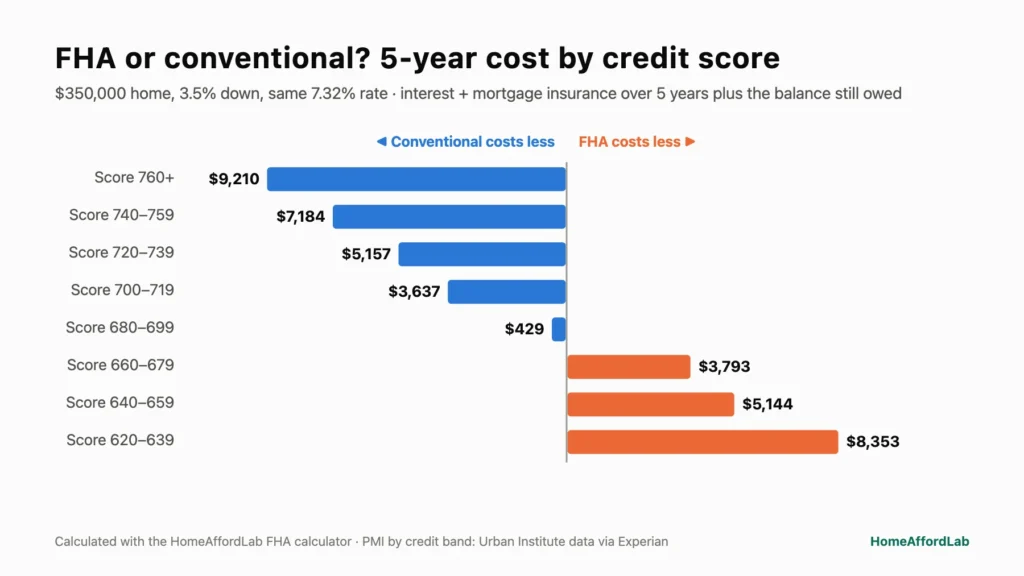
Two things can shift the result. First, FHA rates are often a little lower than conventional rates for the same borrower. In our example, if the FHA quote were 7.07% instead of 7.32%, FHA would come out about $4,743 ahead at a 680 score, while conventional would still win by about $4,039 at 760 and above. Second, conventional PMI can be removed once you reach enough equity, while FHA MIP with less than 10% down cannot. Always compare real quotes for both loans.
How to get rid of FHA mortgage insurance
- Put at least 10% down. The annual premium then ends after 11 years.
- Refinance into a conventional loan. Once you have about 20% equity, a conventional loan without PMI removes MIP. This makes the most sense when rates are similar or lower than your current one.
- Sell the home. MIP ends when the loan is paid off.
If refinancing is your plan, use our mortgage payment calculator to see how quickly your balance falls toward 80% of the home’s value.
FHA loan pros and cons
Pros
- Down payment as low as 3.5%, with gifts from family allowed.
- Credit scores as low as 580 for the minimum down payment.
- The same mortgage insurance price regardless of credit score.
- More flexible debt-to-income limits than many conventional loans.
Cons
- A 1.75% upfront premium on every loan.
- Annual MIP that lasts for the life of the loan with less than 10% down.
- Loan limits that may be too low in expensive markets.
- Stricter property standards in the FHA appraisal, which can rule out homes that need major repairs.
Frequently asked questions
What credit score do I need for an FHA loan?
FHA rules allow a score as low as 580 with 3.5% down and 500 to 579 with 10% down. Many lenders require 580 to 620 or more, so shop around if your score is near those levels.
Are FHA loans only for first-time buyers?
No. Repeat buyers can use FHA loans too, as long as the home will be their primary residence and they meet the other requirements.
Can my down payment be a gift?
Yes. FHA allows gift funds for the down payment from sources such as family members, with a gift letter documenting that the money doesn’t need to be repaid. Your lender will tell you exactly what paperwork it needs.
How much is the FHA upfront premium on a $300,000 loan?
It is 1.75% of the base loan, or $5,250 on $300,000. Most borrowers add it to the loan balance, which raises the loan to $305,250.
How much house can I afford with an FHA loan?
FHA lenders typically look for a housing payment of up to 31% of gross income and total debts up to 43%. Our home affordability calculator includes an FHA option that applies those limits to your income.
The bottom line
An FHA loan can get you into a home with 3.5% down and a credit score as low as 580, at the cost of a 1.75% upfront premium and annual mortgage insurance that usually lasts for the life of the loan. At the same interest rate, FHA tends to be cheaper below a 680 credit score and conventional tends to be cheaper above it. Run your own numbers in the FHA calculator above, then get quotes for both loan types before you decide.
Estimates only. HomeAffordLab is not a lender and does not provide financial advice. This page may contain ads. See our Advertising Disclosure.
Sources: HUD: 2026 FHA loan limits · HUD Mortgagee Letter 2023-05 (annual MIP rates) · NerdWallet: FHA loan requirements for 2026 · Experian: PMI cost by credit score (Urban Institute data) · Freddie Mac Primary Mortgage Market Survey