
By the HomeAffordLab team · Last updated October 26, 2026
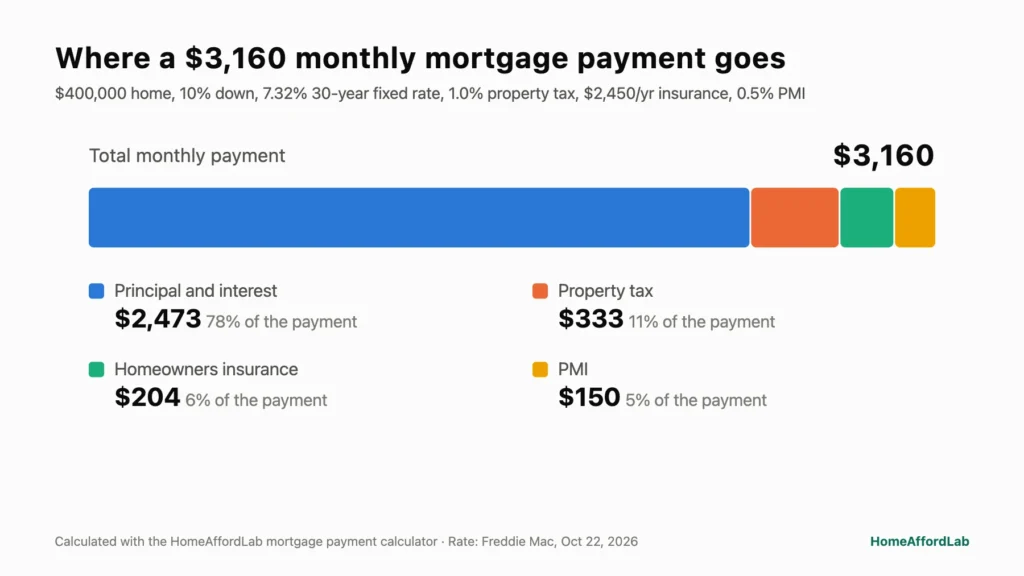
On a $400,000 home with 10% down and today’s average 30-year rate of 7.32%, the full monthly mortgage payment is about $3,160. That is $2,473 in principal and interest, $333 in property tax, $204 in homeowners insurance, and $150 in private mortgage insurance (PMI). Lenders call the first four pieces PITI, and it is the number that actually leaves your bank account each month.
This guide is for buyers who want to see the whole payment before they make an offer. Enter a home price below to get your payment, total interest, the date PMI drops off, and a year-by-year amortization schedule. Then read on to see what drives each part of the bill.
Key takeaways
- Taxes, insurance, and PMI add about $690 a month to the $400,000 example, or 22% of the payment.
- In the first year of a 30-year loan at 7.32%, 88% of what you pay toward the loan is interest.
- A 15-year loan costs about $700 more a month in principal and interest but saves roughly $319,000 in interest.
- Paying an extra $200 a month cuts about 6 years off the loan and saves around $133,000 in interest.
- PMI ends automatically when your balance is scheduled to reach 78% of the home’s original value, about 10 years in at today’s rates with 10% down.
In this guide: What’s in a payment · How it’s calculated · Payments by home price · How rates change it · 15 vs. 30 years · Down payment and PMI · Taxes and insurance · Amortization · Lowering your payment · FAQ
Mortgage Payment Calculator
Your full monthly payment: principal, interest, property tax, homeowners insurance, PMI or FHA mortgage insurance, and HOA dues.
Loan balance and what you pay over time
Each year’s principal and interest, and the balance left at year end.
Year-by-year amortization table
| Year | Principal | Interest | Balance |
|---|
What’s included in a monthly mortgage payment
Most lenders collect more than the loan payment itself. They add property taxes and homeowners insurance to an escrow account and pay those bills for you, so all of it arrives as one monthly charge.
| Part of the payment | What it pays for | $400,000 home, 10% down |
|---|---|---|
| Principal & interest | Paying down the loan balance plus the lender’s interest charge | $2,473 |
| Property tax | Local taxes, collected into escrow | $333 |
| Homeowners insurance | Coverage for the home, collected into escrow | $204 |
| PMI or FHA MIP | Insurance that protects the lender when you put down less than 20% | $150 |
| HOA dues | Community association fees, usually paid separately | $0 in this example |
| Total | $3,160 |
Principal and interest stay the same for the life of a fixed-rate loan. Taxes and insurance do not. Your servicer reviews the escrow account each year, so the total payment can rise when your tax bill or insurance premium goes up.
How your mortgage payment is calculated
The principal-and-interest part uses the standard amortization formula:
M = P × r(1 + r)n ÷ [(1 + r)n − 1]
Here P is the loan amount, r is the monthly interest rate (the annual rate divided by 12), and n is the number of monthly payments. For a $360,000 loan at 7.32% over 30 years, r is 0.0061 and n is 360, which gives $2,473 a month. The calculator then adds one-twelfth of the yearly property tax and insurance, plus mortgage insurance and HOA dues.
Mortgage payments by home price
The table assumes 10% down, a 7.32% 30-year conventional loan, property tax of 1.0% of the price, $2,450 a year in insurance, and PMI at 0.5% of the loan.
| Home price | Principal & interest | Full monthly payment |
|---|---|---|
| $250,000 | $1,546 | $2,052 |
| $300,000 | $1,855 | $2,421 |
| $350,000 | $2,164 | $2,791 |
| $400,000 | $2,473 | $3,160 |
| $500,000 | $3,091 | $3,900 |
| $600,000 | $3,709 | $4,639 |
Not sure which price fits your budget? Our home affordability calculator works the other way around, starting from your income and debts.
How interest rates change your payment
Freddie Mac’s weekly survey put the average 30-year fixed rate at 7.32% on October 22, 2026. Here is what each half-point means for the $400,000 example: Paying mortgage points is one way to buy a lower rate.
| 30-year rate | Full monthly payment | Total interest over 30 years |
|---|---|---|
| 6.32% | $2,920 | $443,879 |
| 6.82% | $3,039 | $486,622 |
| 7.32% | $3,160 | $530,262 |
| 7.82% | $3,284 | $574,747 |
Each half-point moves the payment by about $120 a month and total interest by more than $40,000. Rates vary by lender, so a quote even a quarter-point lower is worth real money. The Consumer Financial Protection Bureau suggests requesting Loan Estimates from several lenders and comparing them side by side.
15-year vs. 30-year mortgage
Shorter loans carry lower rates and far less interest, but a higher monthly payment. Freddie Mac’s 15-year average was 6.68% on October 22, 2026. See our 15-year vs. 30-year mortgage comparison for the full trade-off.
| $360,000 loan | 30-year at 7.32% | 15-year at 6.68% |
|---|---|---|
| Principal & interest | $2,473 | $3,172 |
| Full monthly payment | $3,160 | $3,859 |
| Total interest | $530,262 | $210,909 |
| PMI ends after | About 10 years | About 3 years |
The 15-year loan saves about $319,000 in interest for roughly $700 more a month. If that payment is too tight, a 30-year loan with extra principal payments gives you some of the savings while keeping a lower required payment.
Down payment, PMI, and FHA mortgage insurance
With less than 20% down on a conventional loan, lenders require private mortgage insurance. PMI typically costs between 0.46% and 1.50% of the loan amount per year, depending mostly on your credit score, according to Urban Institute data cited by Experian. On a $360,000 loan, that is about $138 to $450 a month. Our PMI guide shows the cost by credit score and how to remove it.
| Down payment on $400,000 | Loan amount | Monthly mortgage insurance | Full monthly payment | Mortgage insurance ends |
|---|---|---|---|---|
| 3% conventional | $388,000 | $162 | $3,364 | About 13 years |
| 3.5% FHA | $392,755* | $177 | $3,412 | Life of the loan |
| 5% conventional | $380,000 | $158 | $3,306 | About 12 years |
| 10% conventional | $360,000 | $150 | $3,160 | About 10 years |
| 20% conventional | $320,000 | $0 | $2,736 | No PMI |
*Includes the 1.75% upfront FHA premium, which most borrowers add to the loan. Conventional figures assume PMI at 0.5% a year; buyers with lower credit scores often pay more.
When PMI goes away
Under the federal Homeowners Protection Act, as explained by the Consumer Financial Protection Bureau:
- You can ask to cancel PMI once your balance is scheduled to reach 80% of the home’s original value, or earlier if extra payments get you there. You need a good payment history, no second mortgage, and possibly an appraisal showing the value hasn’t dropped.
- PMI ends automatically when your balance is scheduled to reach 78% of the original value, as long as you are current on payments.
- It must end by the midpoint of the loan term, 15 years into a 30-year loan, even if the balance hasn’t reached 78%.
FHA mortgage insurance follows different rules. With less than 10% down, it lasts for the life of the loan unless you refinance. With 10% or more down, it ends after 11 years. Our FHA loan calculator shows the exact premium and compares FHA with a conventional loan.
Property taxes and homeowners insurance by location
Where you buy can change the payment as much as the price does. Effective property tax rates range from 0.27% in Hawaii to 2.23% in New Jersey, based on Tax Foundation data. On the $400,000 example, that is $90 a month in Hawaii versus $743 in New Jersey, a difference of more than $650. Our escrow guide explains how these costs are collected and why they change.
Insurance varies just as widely. Bankrate puts the national average at $2,424 a year for $300,000 of dwelling coverage, while Insurance.com data shows Florida homeowners paying an average of $8,471 a year in 2026. At that premium, the example payment rises from $3,160 to about $3,662. Ask for an insurance quote and check the county tax rate before you make an offer.
How amortization works
Early payments go mostly to interest because interest is charged on a large balance. In the first year of the $360,000 loan at 7.32%, you would pay about $26,238 in interest and only $3,437 in principal. Principal doesn’t overtake interest until year 22. The chart in the calculator shows this shift, and the year-by-year table lists the balance at the end of each year.
That is also why extra payments early in the loan are so powerful. Adding $200 a month to principal on the example loan pays it off in 23 years and 8 months instead of 30 years and cuts total interest from $530,262 to $397,532, a saving of about $133,000. Try it with the “Extra principal payment” field in the calculator.
How to lower your monthly mortgage payment
- Shop for a better rate. Compare Loan Estimates from at least three lenders.
- Raise your credit score before you apply. A higher score can lower both your rate and your PMI premium.
- Put more down if you can. Reaching 20% removes PMI entirely; in the example, that cuts the payment by $424 a month.
- Remove PMI as soon as you qualify. Track your balance and request cancellation at 80% of the original value.
- Shop homeowners insurance every year or two. Premiums vary widely between insurers for the same home.
- Check your property tax assessment. If it looks too high compared with similar homes, most counties let you appeal.
Frequently asked questions
What is the monthly payment on a $300,000 house?
With 10% down and a 7.32% 30-year loan, about $2,421 a month including average property tax, insurance, and PMI. Principal and interest alone are $1,855. With 20% down, PMI disappears and the loan is smaller, so the payment falls further.
Does my mortgage payment ever change on a fixed-rate loan?
The principal-and-interest part never changes. The escrow part can, because your servicer recalculates it each year based on your actual tax bill and insurance premium. Removing PMI also lowers the payment.
How much of my income should go to a mortgage payment?
A common guideline is to keep the full housing payment at or under 28% of your gross monthly income and all debt payments at or under 36%. See our guide to how much house you can afford for the full rule and examples.
Is it better to make extra payments or invest the money?
Extra payments earn a guaranteed return equal to your mortgage rate, 7.32% in today’s market, and reduce risk. Investing may earn more over time but with ups and downs. Many people first build an emergency fund and capture any employer retirement match, then decide.
Why is my lender’s payment estimate different from this calculator?
Your Loan Estimate uses your actual rate, credit-based PMI quote, local tax rate, and insurance premium. Our calculator uses averages you can edit. Replace the defaults with your own figures for a closer match.
The bottom line
Your real mortgage payment is principal and interest plus taxes, insurance, and mortgage insurance. On a typical $400,000 purchase with 10% down at today’s rates, that comes to about $3,160 a month, with roughly $690 coming from costs outside the loan itself. Use the calculator above with your own price, rate, and local costs, and check what price fits your income with our affordability calculator.
Estimates only. HomeAffordLab is not a lender and does not provide financial advice. This page may contain ads. See our Advertising Disclosure.
Sources: Freddie Mac Primary Mortgage Market Survey · CFPB: When can I remove PMI? · Experian: How much does PMI cost? · HUD Mortgagee Letter 2023-05 (FHA premiums) · Tax Foundation, Property Taxes by State and County, 2026 · Bankrate homeowners insurance costs